Bio

Bonnie Vysotsky is a Baltimore based artist working in multiple mediums – fibers, ceramics, and painting.
Working in a wide range of media and processes fuels her work and reflects her years as an art educator. Bonnie was raised in St. Petersburg, Florida and attended Pinellas County Center for the Arts, a magnet high school. In 1991 she attended the Maryland Institute College of Art as a painting major, but fell deeply in love with fibers and ceramics. During her time at MICA she studied abroad at the Edinburgh College of Art to study painting and printmaking. While in Edinburgh, her interest in architecture and textiles were sparked.
After graduating in 1995, Bonnie began designing garments and installations that reflected idealized perceptions of domesticity and showcased her work at a variety of fashion shows and festivals, and was published in Baltimore Magazine. During this time she worked in museums as a stipend intern creating educational tools and activities at the National Textile Museum in Washington, D.C., The Maryland Historical Society, and others. In 2000 she received her Master’s degree in Art Education from the Maryland Institute College of Art and began teaching elementary art in Baltimore County.
While with Baltimore County she was part of the curriculum writing team for Discovering Learning and Literacy Through the Arts in conjunction with The Walters Art Museum. Until 2021 she was a Girl Scout Leader and taught art and painting to students ranging from toddlers to adults, which fulfilled her interest in all levels of developmental learning. Presently, Bonnie is teaching Pre-Primary and Middle School at Friends School of Baltimore.
Artist Statement
Live Well / Livewell Series
My perspective of our relationship to the ocean was fostered during the 1980s. As the daughter of a commercial fisherman, a shrimper in Tampa Bay and the Gulf of Mexico, my earliest experiences of pulling in nets, opening the purse and dumping the catch on the sorting table to investigate with all of my senses is forever with me – the misty salt smell, touching textures that trick you, the sound of the birds, dolphins, and turtles following their wee shrimpboat that are competing with the rumble of the diesel engine. My curiosity expanded to the ocean floor and its systems, and the very direct impact the waters had on their daily lives.
We ate our by-catch*. Paying the bills was dependent on if we could take the boat out or not. I have many stories of this way of life to the point where it’s become my own mythos, which has naturally progressed into a recurring theme in my work.
In 2010, I went home to explore the docks of my past after realizing that I had never focused my work on my relationship to the water and its inhabitants. What I found was shocking. The shrimp boats were gone; replaced by pleasure boats. No live wells. No nets. Where did they go? I then started to ask questions at the bait shops and explored articles on the internet.
With the dawn of smartphones, shrimpers could share their personal experiences with each other and the wider public. I joined as many shrimper groups on social media as possible to learn all I could. In 2008 the combination of the gulf oil spill, high gas prices and the very damaged estuary made it impossible for smaller shrimpers to make a living, let alone leave the dock; a perfect storm of environmental impacts.
Those are the high visibility factors, but my dad would often say, “If you want to know what’s happening to the shrimp, you need to look smaller.” Scientists have only been studying the microbial life of the Gulf of Mexico since the 1990s, so data sets are incomplete. But what is happening to the tiny organisms? What has changed and what was lost? What about the seafloor, and ocean passengers? Humans are studying and working toward answers and resolutions for these questions. With microplastics in our drinking water and fisheries collapsing, it’s clear our human impact is both large and small.
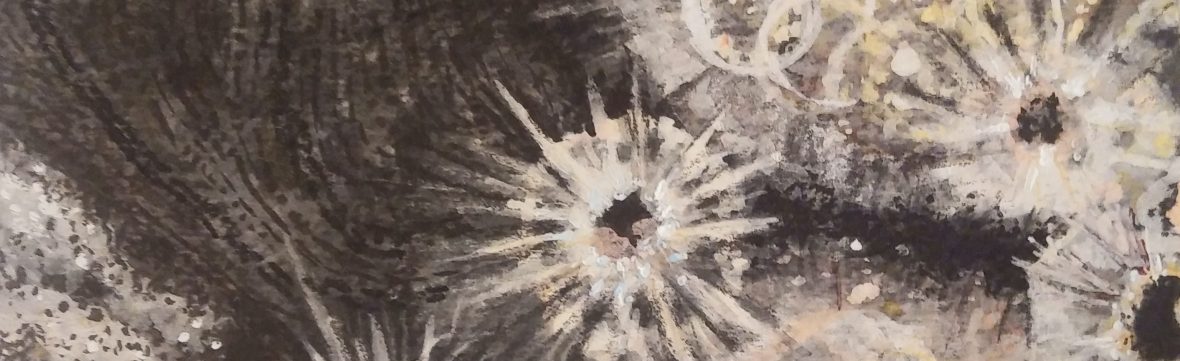
A common thread in my work is the morphology of the axial complex, this happens when the human eye looks up at the dome and arches of a Cathedral, but also in a soft-bodied moving sea creature. While working on this series, I was absorbing thoughts of how flocking, the byproduct of bacteria that digested the petroleum goo, is making its mark on ocean creatures and its reaction to it? How corn farming runoff and sugar processing traverses water flow and how the smallest residents will proceed?
I use fiber, ceramics, and painting and tends to delve into the painting process and leans hard into color no matter what medium I am working in. Building layers of tiny parts to create a whole, with precarious delicate components is another art habit, which is why I use cone 6 porcelain in my ceramic work.
As anyone who endeavors to make art, I am hoping to ignite more thoughts, more questions, contribute to evolving perspectives, and make connections with the community around me.
* livewell – a water tank found on many fishing boats that is used to keep bait and caught fish alive. It works by pumping fresh water from the surrounding body into the tank, as well as keeping the water aerated. Wikipedia
 Bonnie Lee Vysotsky